
For more than three decades, Astrid Frisch Jordán has built a life around a simple but powerful connection: the more we understand nature, the better prepared we are to protect it.
A Mexican biologist, whale researcher, conservationist and co-founder of Ecotours Vallarta, Astrid has played an important role in the development of responsible ecotourism and humpback whale research in Puerto Vallarta and Banderas Bay.
Her work brings together science, tourism, environmental education and direct conservation action — from identifying individual humpback whales and studying their migrations to training whale-watching operators and coordinating teams that respond when whales become entangled in fishing gear.
A Pioneer of Ecotourism in Mexico
Astrid co-founded Ecotours Vallarta with Karel Beets in 1991, with the idea of offering travelers a different way to experience Mexico: through nature, knowledge and responsible exploration.
At a time when ecotourism was still developing as a concept in Mexico, Ecotours Vallarta began creating experiences led by knowledgeable naturalist guides, with conservation and environmental education at the heart of the journey.
The company became one of the pioneering ecotourism operators in the country and was also a founding member of the Mexican Association of Adventure Travel and Ecotourism (AMTAVE). Over the years, Ecotours Vallarta has led nature experiences for organizations including the World Wildlife Fund (WWF), the American Museum of Natural History in New York, the Saint Louis Zoo and the National Wildlife Federation.
For Astrid, tourism and conservation were never separate worlds. Ecotourism became a way to bring people closer to wildlife while encouraging them to understand why those animals and ecosystems need protection.
From Biology to the Whales of Banderas Bay
Astrid studied Biology at the National Autonomous University of Mexico (UNAM), receiving her professional degree in 1996.
That same year marked the beginning of one of the projects that would become central to her scientific career: the Humpback Whale Photo-Identification Catalog of Banderas Bay, commonly known as the FIBB Catalog.
Humpback whales can be individually identified by the unique patterns, pigmentation, scars and shapes found on the underside of their tail flukes. Photographing and comparing these markings allows researchers to recognize individual whales when they return in subsequent seasons or when they are encountered elsewhere in the Pacific.
What began as a regional research effort has grown into an extraordinary long-term record of the whales visiting the Mexican Pacific.
Today, ECOBAC reports that the FIBB Catalog contains approximately 3,800 individually identified whales and more than 13,000 records.
These decades of observations help researchers understand migration patterns, population changes, breeding behavior, habitat use and the connections between humpback whales seen in Mexico and those recorded thousands of kilometers away.
Turning Whale Watching into Whale Conservation
Astrid’s contribution to Banderas Bay goes beyond identifying whales.
She has worked for years to promote a culture of responsible whale watching, helping tour guides, captains and boat operators understand that approaching a whale is both a privilege and a responsibility.
Through ECOBAC, she has participated in training programs for authorized whale-watching operators, educational campaigns and initiatives designed to encourage better navigation practices around whales. ECOBAC records training and outreach work with operators in Jalisco and Nayarit extending over many years, as well as its participation in the development of whale-watching guidance with the International Whaling Commission.
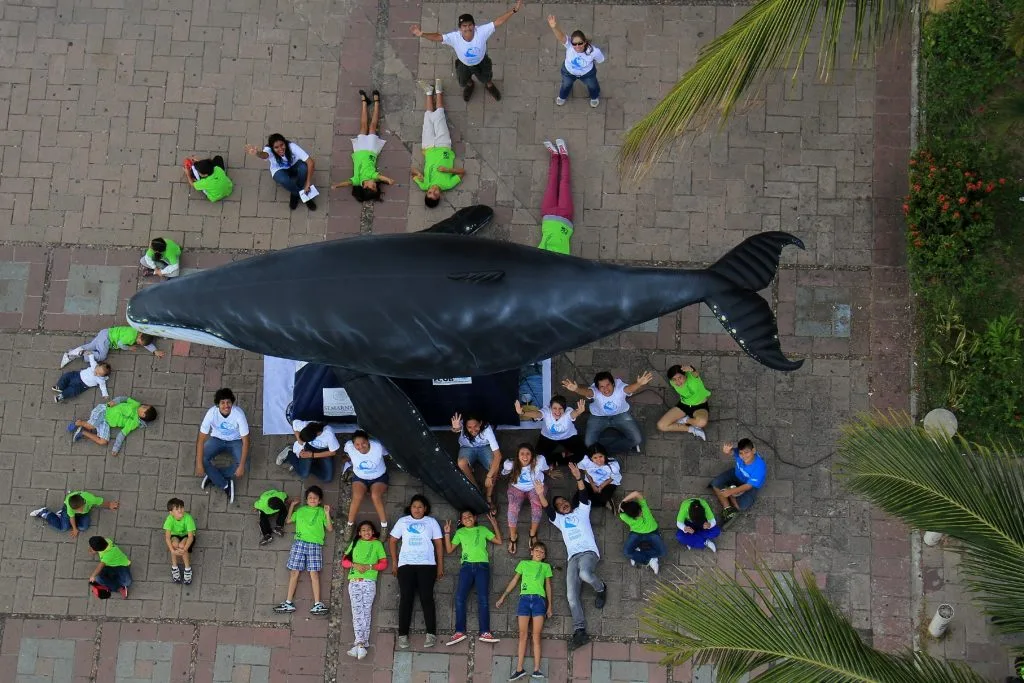
This work has helped connect scientific knowledge with what happens every day on the water.
For visitors, a whale-watching tour may last only a few hours. For researchers and conservationists like Astrid, every encounter is part of a much larger story involving animal behavior, migration, reproduction, vessel traffic and the long-term survival of whale populations.
ECOBAC: Research that Leads to Action
Astrid is the head researcher of Ecología y Conservación de Ballenas A.C. (ECOBAC), an organization dedicated to whale research, environmental education and conservation.
Her work has included marine mammal surveys in both the North Atlantic and Mexican Pacific, along with collaborations involving Mexican universities and international research initiatives.
ECOBAC has participated in major collaborative projects such as SPLASH — Structure of Populations, Levels of Abundance and Status of Humpback Whales in the North Pacific, which brought researchers together to improve understanding of humpback whale population structure and abundance across the ocean basin.
Astrid continues to contribute to scientific research on humpback whales. Her published work includes studies of population patterns in Banderas Bay, feeding behavior, whale entanglements, migratory connections and critical breeding habitat.
Recent research involving Astrid has examined important humpback whale calving habitat in Banderas Bay and documented long-distance migratory connections between whales identified in Mexico and the Russian Far East. Her research profile currently lists dozens of scientific publications and collaborations.
Her work is therefore not only about observing the whales that arrive in Puerto Vallarta each winter. The information collected in Banderas Bay contributes to a much broader understanding of humpback whales across the North Pacific.
RABEN: When Conservation Becomes Rescue
Some of Astrid’s most important conservation work takes place when a whale is in immediate danger.
Whales occasionally become entangled in fishing lines, nets and other fishing gear. These incidents can cause severe injuries, restrict a whale’s ability to swim and feed, and in some cases can be fatal.
Astrid coordinates the Mexican Whale Disentanglement Network, RABEN, and is currently listed as its National Coordinator, as well as coordinator of the Banderas Bay team.
The network brings together specially trained teams along Mexico’s Pacific coast to respond to reports of entangled large whales.
This is highly specialized work. Attempting to free a large whale without appropriate training can be extremely dangerous for both the animal and the people involved. For this reason, one of RABEN’s central goals is not only responding to entanglements, but also training teams, improving response capacity, collecting information and preventing unsafe interventions.
ECOBAC’s involvement with whale disentanglement dates back to its first recorded humpback whale rescue in 2004. Between 2012 and 2015, the national RABEN network expanded from a single team to 15 teams, training 180 members in collaboration with CONANP. It later joined the International Whaling Commission’s Global Whale Entanglement Response Network.
Today, RABEN describes a nationwide network of 16 specialized teams working not only to respond to entangled whales, but increasingly to understand and prevent the causes of these incidents.
Science, Tourism and Responsibility
Astrid’s career is difficult to define with a single title.
She is a biologist and researcher, but she has also spent decades working directly with tour guides, captains, students, researchers and visitors.
She is an ecotourism entrepreneur, but much of her work has been dedicated to establishing limits and responsible practices that protect the very wildlife tourism depends upon.
She studies whales through photographs and data, yet she also coordinates teams that may have to approach a distressed whale at sea and make decisions in real time.
These different roles share a common idea: wildlife tourism can create a meaningful connection between people and nature, but only when that experience is built on knowledge and respect.
That principle has been part of Ecotours Vallarta from its earliest years.
More Than Three Decades in Banderas Bay
Since the early 1990s, Astrid Frisch Jordán has helped connect visitors with Mexico’s natural world while simultaneously working to understand and protect it.
From co-founding Ecotours Vallarta to building one of the most important long-term humpback whale identification records in the region, from educating whale-watching operators to leading Mexico’s whale disentanglement network, her professional life reflects the evolution of ecotourism itself — from simply observing wildlife to actively participating in its conservation.
Every winter, humpback whales return to Banderas Bay.
Some are new visitors. Others have been photographed and identified many times before.
And behind those encounters lies decades of patient work: photographs taken, flukes compared, data recorded, operators trained, students mentored and whales protected.
For Astrid, the whales of Banderas Bay are not simply one of Puerto Vallarta’s great natural attractions.
They are individuals, research subjects, ambassadors for the ocean — and animals worth knowing well enough to protect.