
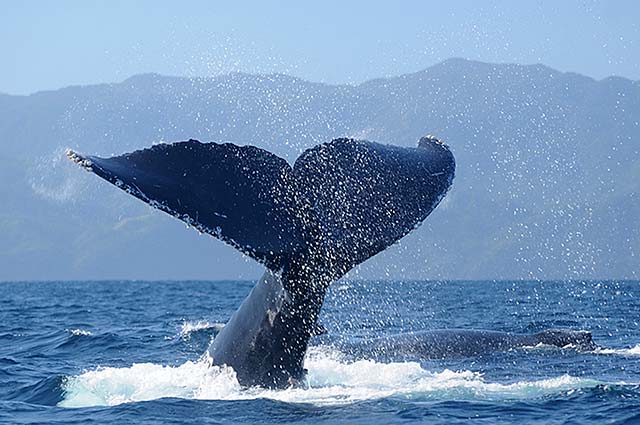
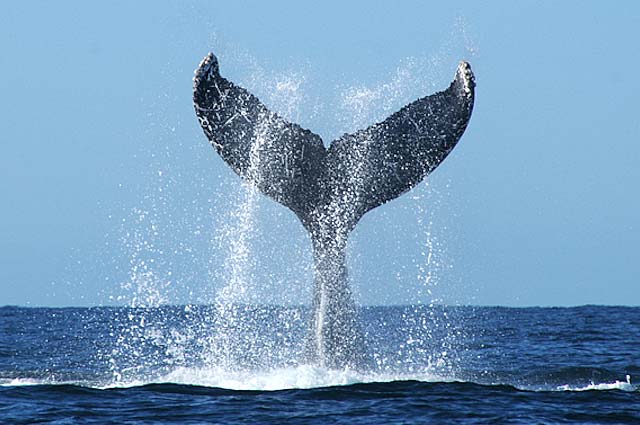
This technique consists of obtaining a photograph of the underside of a humpback’s fluke. The fluke presents a coloration pattern that ranges from completely white to completely black, with scars, lines, spots and notches that — together with its border, shape, and the size of the central notch — provide the whale with characteristics unique to each adult individual (Katona & Whitehead, 1981). This allows scientists to distinguish one individual from another, just as with human fingerprints. The shape and scars of the dorsal fin can also provide information about a whale’s identity.
Beside capturing the humpbacks’ magnificence, these photographs provide information used to estimate population numbers, study behavior, birth rates, migration routes, and much more.
The FIBB Catalog
Ecotours Vallarta collaborates with the Humpback Whale in Banderas Bay Photoidentification Catalog, known as the FIBB Catalog. To date, the catalog has over 1,300 different individuals photoidentified and a database of more than 3,500 records. Astrid Frisch, co-owner of Ecotours Vallarta, is the head researcher of the Humpback Whale in Banderas Bay and Nayarit Coast Photoidentification Project.
Since 1996, the Instituto Tecnológico de Bahía de Banderas, Centro Regional de Investigación Pesquera-INP Cruz de Huanacaxtle, and whale watching tour operators have carried out photoidentification projects with humpback whales (Megaptera novaeangliae) in Bahía de Banderas, Jalisco-Nayarit, México. In an effort to gather more complete information for the research, conservation, and protection of the species, all the photos and data were compiled into the FIBB Catalog. Because collaborators launch from different harbors within Banderas Bay (Puerto Vallarta, Nuevo Vallarta, Cruz de Huanacaxtle, and Punta de Mita), at least 60% of the Bay is covered daily during whale watching season (December 8 to March 23), with a minimum navigation effort of 12 hours.
A printed version of the catalog is available, including the results of 10 years of research and a section on humpback whale biology and behavior — $30 USD plus shipping (write to fibbcatalogo@yahoo.com). Proceeds benefit the Humpback Whale Research and Conservation Project.
According to FIBB Catalog results, the minimum number of humpback whales in Mexico’s coastal stock is 1,300 individuals — the number of different whales identified to date. Urbán et al. (1999) estimate the coastal population’s abundance at 1,813 individuals (95% CI: 918–2505), and Frisch (2004) estimates the population can reach 2,200 individuals.
When joining efforts and collaborating with the FIBB Catalog, we’re not only registering the different whales that visit Banderas Bay — we’re also gathering more information on each individual and building a more complete catalog, which is valuable both for the study and conservation of the humpback whale and for the management of the whale watching activity.
Over the 10 field seasons, the group effort has kept growing, and each season more and better photos and data are gathered. In 2004, 2005 and 2006, the FIBB Catalog collaborated with SPLASH (Structure and Population Abundance of Humpback Whales in the North Pacific), an international project, as well as with the NOPP OBIS SEAMAP (Ocean Biogeographic Information System) project, UNAM, and UABCS. Whale watching tour operators are important contributors to gathering data for humpback whale research in Banderas Bay.
About ECOBAC
Visit ecobac.org to learn more about conservation efforts in Banderas Bay. ECOBAC’s main objectives:
- Encourage marine mammal research projects on the coasts of Jalisco and Nayarit, an important area for the conservation of species as the entrance to the Sea of Cortés
- Promote the exchange of knowledge and information for wildlife conservation and protection
- Create a wildlife conservation, information, and research center
- Promote training of specialized ecotourism guides through courses, scholarships and workshops, to encourage sustainable development and wildlife conservation
Action plans: Research, Outreach and Environmental Education, Conservation Projects, Ecotourism and Sustainable Development.